
Why Systems Coaching?
How we learn, function, and follow through is shaped by the system around us.
Systems Coaching is built on a simple truth: people do not function in isolation. Our ability to learn, regulate, work, recover, and grow is shaped by the environments, relationships, expectations, and supports around us.
When those systems are aligned, people are more able to access clarity, consistency, resilience, and follow-through. When they are not, even highly capable people can feel overwhelmed, stuck, inconsistent, or shut down.
This is especially true for neurodivergent people, who often struggle because the systems around them are not aligned with how they function.

What is Systems Coaching?
Systems Coaching is a holistic model for improving how people function in real life. It moves beyond simply addressing symptoms or expecting individuals to "try harder" within broken patterns. Instead, it looks at the full picture—the conditions and environments that shape how a person learns, works, and manages emotion.
The goal is not short-term compliance. It is a practical, humane, and lasting change.
Why a Systems Approach Matters
Traditional support often addresses only one part of a larger picture:
Tutoring handles content, therapy addresses distress, and workplaces focus solely on performance.
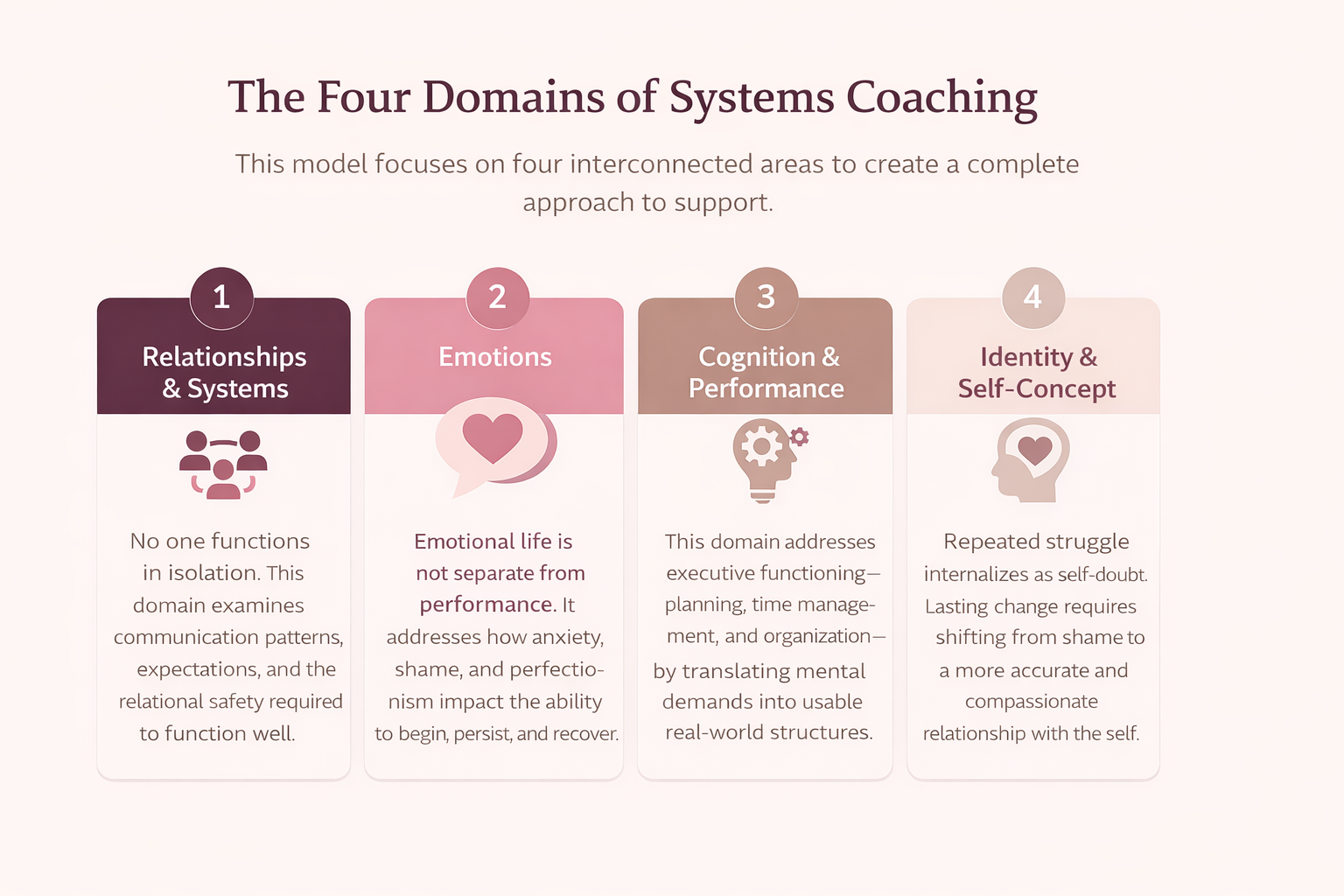
But people do not live in one category at a time. Systems Coaching addresses the interconnected reality:
Emotional overwhelm can block cognitive capacity.
Executive function challenges can look like resistance when it is actually due to overload.
Inconsistent environments erode follow-through over time.

Systems Coaching in Practice
The work is applied, integrative, and grounded in daily life. The process involves:
Identifying what is interfering with follow-through.
Creating clearer structures, routines, and expectations.
Reducing overload by aligning demands with capacity.
Strengthening communication and relational steadiness.
Intellectual Foundations
The Systems Coaching Model™ is grounded in cross-disciplinary scholarship, treating functioning as something shaped within a system, not located solely within an individual. This includes research in neurodiversity-affirming practice and person-environment fit, which supports the view that struggle is shaped by how well surrounding systems align with a person’s way of functioning.
Citation: Research in neurodiversity-affirming practice supports the view that neurodivergent struggle is shaped not only by the individual, but by how well the surrounding systems align with that person’s way of functioning (Leadbitter et al., 2021; Chapman & Botha, 2023).